Political Sandbox

Political Sandbox
If you want to read my latest writing click above


Thoughts on politics and life from a liberal perspective

Showing posts with label Labour. Show all posts

Sunday, 26 June 2016

Why I have just joined the Labour Party. And why you should too. Seriously.

I have just joined the Labour Party.

Before long term readers of this blog start thinking I've gone peculiar let me assure you that there is method in this.

Firstly, I will state for the record that I certainly consider myself to support Labour's "aims and values" which is what you have to be able to do to be a member. As I've mentioned before I consider this a fairly vague thing to have to adhere to but in so far as I want to see social justice in this country I certainly think I have at least as much in common with those goals as e.g. someone like Peter Mandelson. Or Tony Blair. Both of whom as far as I know are still Labour members.

OK, that's the admin out of the way (in case the Labour Party "Compliance Unit" (seriously that's a thing) are reading this).

To the method.

We have just had the most politically revolutionary event in this country since the second world war. All the pieces have been thrown up in the air and they will be falling down and settling over the next few months and years. The Tories are about start a contest to elect their new leader and hence Prime Minister. As I outlined earlier today that is very likely to lead in short order to a general election.

Let's face it, it's going to be Boris Johnson.

In the meantime as I am writing this 8 shadow cabinet ministers have either been sacked or have resigned in order to try and force a leadership contest to unseat Jeremy Corbyn as leader. I think Corbyn, although a very nice man is simply out of his depth as leader and hence would lead the party to a serious defeat at the coming election. If you thought it was bad for Ed Miliband (who actually didn't really have much of a track-record for the Tories to attack) just imagine what it is going to be like for a man with Corbyn's history and all the platforms he has shared with... Well, you've all seen the pictures. You know what I'm talking about and what will happen. He'll be thrashed.

It is costing me £3.92 per month to be a member of the Labour Party. That is a small price to pay if like me, you do not want to see a demagogic charlatan like Boris Johnson have such an easy run at hugely increasing his majority in a few months time. If you agree then you should also join so you have a say in choosing the next leader who after Johnson is likely to be the most significant politician in the country.

These are serious times and it simply cannot be left to the left wing activists who flocked to Labour last year to get to choose who this person should be. They had their chance last year and they have utterly failed. So please, if you can afford a few quid a month join Labour in order to make sure you have a vote in the contest to ensure there is a stronger opposition to one of the worst politicians I can imagine becoming Prime Minister.

You don't have to remain a member in the long term. I may do, I may not. That's not my concern right now. I'm simply looking at trying to make sure that Her Majesty's Loyal Opposition can do a proper job during the biggest political crisis of my lifetime.

Will you join me?

Sunday, 3 January 2016

Labour have forfeited any right to complain about boundary changes

So the (evil natch) Tories have got themselves a majority and are now going to press ahead with boundary reform. They intend to reduce the number of MPs from 650 to 600 and also to even up the number of voters in constituencies to within about a 5% margin. This is in contrast to the situation at the moment where there can be huge disparities between numbers of voters with some constituencies being 4 or 5 times the size of others.

Now before I get into how Labour have no right to whine about this let me just reiterate my long held position on our electoral system. I think First Past the Post is not fit for purpose. I think it hugely distorts results, forces parties to focus on a tiny number of swing voters in marginal seats and prevents new parties from getting a foothold hence allowing our atrophied and sclerotic politics to perpetuate.

But Labour don't agree with this. Since the Second World War they have been in power cumulatively for 30 years, most recently the 13 years from 1997 to 2010. In all those long years, and especially when Blair had his big majorities between 1997 and 2005 they could easily have put through a change to the electoral system to make it more proportional (or what I would call "fairer"). Indeed after the Jenkins Commission (set up by the new Labour government) reported in 1998 and recommended we change to a system of Alternative Vote Plus (a preferential system topped up to add proportionality) they would have had the perfect political opportunity. But they chose not to do this. The system that had served them so well and given them a huge majority was deemed fine and dandy. Blair has subsequently admitted as much.

The boundaries have long favoured Labour because of their vote distribution and the constituency sizes. Until the night of the long sgian dubhs they could expect to get significantly more seats than the Tories even if their vote share had been the same. It's questionable whether this is still the case following their rout in Scotland but nevertheless this held for many, many years.

So what we essentially had was an electoral system that was strongly bent in favour of the two main parties, Labour and the Tories, and then within that bending, it was bent a little further in favour of Labour than the Tories. Labour were fine with the massive bending towards the two main parties, and of course the extra bending towards them in favour of the Tories.

Unsurprisingly the Tories, while happy with the overall massive bending towards the two main parties were not happy with this extra bias towards Labour. They saw an opportunity to "fix" this problematic (for them) part of the system by evening up the constituency sizes and reducing their number. They were (and are) able to use the cover of "making the system fairer" even though the effect will be to bend things more in their favour. Analysis suggests it may give them another 20 or so seats compared to what they would get at the moment. It's not an exact science but most observers agree it will be to their benefit.

And of course Labour are not happy with this change. There are cries of "foul" and "gerrymandering". But they've brought this on entirely themselves. A rotten system that was bent in favour of red/blue hegemony but slightly more towards red will now be a rotten system that will be bent a little more towards blue. But the Tory argument that evening up the constituency sizes will be fairer is very hard to rebut. It is unfair that there is such disparity in the system and Labour could get more seats than the Tories for the same vote. If you accept the premise that FPTP is the best system (as Labour clearly have every time they achieve power) then you simply don't have a leg to stand on trying to claim what the Tories are doing is unfair.

I'd scrap the whole lot and change it to multi-member constituencies using a preferential voting system. But Labour have never done anything like that for Westminster and there are no signs they want that now. Maybe after another 15 years of opposition (which is looking increasingly likely with the Corbyn/McDonnell nexus) they'll change their mind again. Although even if they do I'd have no confidence in them actually changing things were they ever to fluke back into power again.

But in the meantime the best thing they can do about the incipient Tory changes is pipe down.

They long ago forfeited any right to complain about "unfairness" in our electoral system.

Sunday, 13 December 2015

How the Labour party will now be slowly destroyed by our electoral system

Here we go again. Mark banging on about electoral reform.

Well guilty as charged. However I really do feel it is going to play a substantial, probably pivotal role in the evolving disintegration of the Labour Party.

Before I lay out my thesis I should make it clear that despite my obvious opposition to New Labour's more authoritarian aspects and also to the sheer opportunism of the party in opposition between 2010 and 2015 I certainly do not wish to see its demise as a serious political force. Most of my family were Labour supporters when I was growing up. I was delighted with Blair's victory in 1997 and indeed enthusiastically voted for the party in both 1997 and 2001. If I was going to have to choose between 20 years of hegemony from Labour or the Tories I would choose Labour. They are closer to my own political philosophy than the Conservative Party for sure.

But it is becoming increasingly obvious to me that the Labour Party as it is currently constituted will not be here within a decade or two. We have seen a confluence of factors that now militate against its long term survival.

Firstly the membership has changed beyond all recognition from even 6 months ago, let alone 6 years ago. The extraordinary rise of Jeremy Corbyn who only squeaked into the ballot due to acts of charity by several Labour MPs who would never have dreamed he could win and certainly would never have done so had they realised this has triggered an influx of hundreds of thousands of new members, both full and "supporter" level, but all of whom have a vote in leadership elections. Many of these new members are what we used to refer to as "hard left" or even if they don't recognise themselves as such are certainly fellow travellers with much of what the hard left stands for.

Secondly Jeremy Corbyn, John McDonnell and their acolytes now have their hands firmly on the levers of power within the party. And despite their denials it is becoming increasingly obvious that the Momentum group set up to support Corbyn's aims is organising at a grassroots level and will eventually either through confrontation or attrition start to replace more moderate Labour MPs with candidates who are "one of them" to adapt one of Thatcher's most famous phrases.

Thirdly, the mere fact that Corbyn is the leader and groups like Momentum are now so active is leading to more and more people who were previously members of Trotskyist groups and other parties like the SWP etc. joining or in some cases re-joining the Labour Party. They feel like they have got their party back and are swelling the numbers.

A combination of these factors make it almost impossible for Corbyn to be dislodged. He won in the first round with 59.5% of the vote. This is a crushing victory. Burnham only managed 20%. And by way of comparison Blair only got 57% when he stood and won in 1994. Corbyn is master of all he surveys within the party. And the fact that if anything the membership now compared to a few months ago is likely to be even more Corbynite makes it even more difficult to imagine him being successfully challenged.

It is worth bearing in mind as well that if Corbyn is challenged, then according to the Labour Party rules he is on the ballot by default. This means he would no longer need the nominations of 35 Labour MPs to be a candidate in any future election.

The only way I can see the hard left cabal being ousted in the forseeable future would be if Corbyn himself decided to stand down. I wouldn't completely rule this out. It is possible that over the course of the coming months and perhaps couple of years he gets so worn down by the constant attacks from both inside and outside his party and from the media that he eventually chooses to throw in the towel. I have to say though that at the moment this seems pretty unlikely. He appears to be enjoying the job more and more and I doubt he will eschew the chance to remake the party in his own image.

And even if Corbyn did stand down I am certain another left winger, probably McDonnell or someone similar would stand for the leadership. And although the 35 MP threshold would kick in, given how hugely the membership has changed this year I would imagine there would be huge pressure on MPs to at least allow a left winger onto the ballot (who would then of course win). If MPs prevented this I would predict out and out civil war between the membership and the PLP with dozens of deselections happening in short order. Momentum might be largely keeping their powder dry for now but they would definitely not stand for that and they know they have the power to hold the MPs to ransom.

Perhaps the most important question arising from all of this though is why is it happening at all? How can we have a membership of a party that is so at odds with the vast majority of its own MPs? Why is someone like Jeremy Corbyn or John McDonnell even in the same party as say Peter Mandelson or Tristram Hunt or Liz Kendall? It doesn't really make much sense. Those people should really be in a completely different party to each other. Their aims and political anchors are in completely different places.

It's because of the electoral system stupid.

Of course in an ideal world Corbyn and Kendall would be in totally different parties. It was clear during the leadership campaign that they agreed on very little substantively. The problem is that if the hard left or the moderates wanted to split off and form another party the electoral system would punish both sides for doing this. In safe Labour seats where the Tory vote is very weak the left would probably be OK and the Labour Party and Splitters Party could fight each other for those constituencies. But in the vast swathe of marginals and semi-marginals against the Tories or other seats where e.g. UKIP or the Greens or the Lib Dems can run a united Labour Party close a split Labour Party would be a disaster for the left. In dozens, perhaps well over a hundred seats we would see the Tories primarily and perhaps other parties more marginally reap the rewards. Not because these other parties have necessarily done anything to deserve winning these seats but because Labour had split and First Past the Post awards seats to the largest plurality. In simple terms if Labour hold a seat with 50% of the vote where the Tories last time got 30% and Labour splits into two parties where each split party gets 25% of the vote the Tories win even if they still only get 30%.

Of course Labour knows all of this. If they have any doubt they just need to look to recent history and see what happened when Labour split during the 1980s when the Gang of Four formed the SDP. In the following two general elections both Labour and the SDP were hugely punished for being separate parties and the result was 16 more years of Tory government.

If we had a different electoral system based on some form of proportionality a decision to split would be much easier as even if the vote split down the middle (or more likely say the hard left got 10% of the vote and the moderates got 20% or 25% of the vote) then they would get seats allocated in roughly those proportions. And then following an election it's possible that those parties, perhaps in conjunction with others could form a government. But their respective electoral strengths would be clear and the coalition would be formed after an election rather than being forced to cram a load of people who loath and barely even understand each other's politics into the same party before an election.

But we don't have a system like this. And this is why by far and away the most likely scenario is that the Labour Party does not split and instead remains one single party. And slowly but surely that one single party is in the process of destroying itself. The constant off (and increasingly on) the record briefings against each other, the incredulity of many Labour MPs at the behaviour of the leadership (just look at the video of Tom Watson's face when McDonnell recently pulled out Mao's Little Red Book at the despatch box for this in microcosm), the grassroots organising to punish MPs who deviate from the Corbynite line. And eventually, inevitably the proof that Corbyn is unelectable in 2020. But even when this happens that won't stop the hard left. They simply will never accept that their programme is unpopular. They will blame anything but themselves and will instead carry on with their purity drive.

They will eventually after years of this be a hollowed out force with MPs fallen by the wayside replaced with true believers.

This could have been avoided or at least mitigated if the party had been able to separate into the more natural political groupings that common sense would dictate. But that can't happen. Our electoral system simply will not allow it.

It would be easy for someone like me who has campaigned for electoral reform for a long time often in the teeth of opposition from dinosaurs on the Labour benches to find this highly amusing. It is only 4 years since we had the chance to make a change to AV that could have helped facilitate a much better situation for the current Labour Party. But many within Labour fought tooth and nail to prevent this relatively minor but important progressive change to our system and they won. So they will now reap what they sowed.

But I do not find this situation amusing. It is deadly serious. Because the consequence will be probably 20 years at least of Tory governments. A Tory party who knew very well what they were doing when they blocked any chance of a proportional system during the 2010 Lib Dem coalition negotiations and a Tory party who pulled out all the stops (in alliance with those Labour dinosaurs) to prevent AV in 2011.

I suspect eventually Labour will come to see how they have shafted themselves in the long term through their refusal to countenance a more progressive electoral system.

But it will be too late by then. They won't have enough MPs to make any difference any more.

Monday, 24 August 2015

House of Comments - Episode 129 - The Corgasm

The latest House of Comments podcast is now out.

This week the podcast is back for a(nother) one off special during the current podcast hiatus. I am joined by Editor of Politics.co.uk Ian Dunt to discuss the remarkable surge of Jeremy Corbyn and its current and likely future effects.

You can subscribe to the podcast on iTunes here.

Other podcasting software e.g. for Android can be pointed here to subscribe.

Or you can listen to the embedded episode below here:


Any feedback welcomed in the comments below.


PS: A big thanks to Audioboom for hosting the podcast. We would also like to thank Kevin MacLeod from Incompetech.com for our theme music.

Thursday, 13 August 2015

Labour doesn't have any values - so how can new members be required to support them?

I was amused this morning to see that Mark Steel, one of the most outspoken left-wing activists in the media has been banned from joining the Labour Party because he doesn't "support their values":


Now in Mr Steel's case there seems to be some question mark over whether he is still a member of the SWP which could be another reason why he has not been allowed to join and vote in the current leadership contest. But it is worth looking a little bit more closely at the given reason for his rejection, the charge that he does not support their values. Because Labour currently doesn't really have any values.

I don't mean this glibly. I mean it literally.

Labour have just (badly) lost an election that they and many of the rest of us thought they would win, or at least they would form the next government in the aftermath of it. That hasn't happened and they seem to be going through some sort of collective nervous breakdown as a result.

It certainly wasn't clear what the party stood for in the previous parliament. Indeed that is one of the reasons they lost. They spent the first 3 or 4 years of it opposing every single cut the coalition government made and then in the last year or so suddenly tried to turn on a sixpence and claim they were the party of fiscal responsibility (whilst still opposing many of the cuts and claiming they were ideological). They also campaigned hard on the NHS claiming that the coalition was "privatising it" despite having themselves extended private provision whilst in office (at one point under Andy Burnham). There are various other examples of where they either said or did one thing in office and another when in early opposition and then yet another in the run-up to the election. No wonder people were confused.

I saw a journalist remark the other day that when they approached the Labour Party to ask what its values were in order to clarify they were directed to read "Clause 4" of the Labour Party constitution. Here it is as modifed in 1995 under Blair's early leadership:

The Labour Party is a democratic socialist party. It believes that by the strength of our common endeavour we achieve more than we achieve alone, so as to create for each of us the means to realise our true potential and for all of us a community in which power, wealth and opportunity are in the hands of the many, not the few, where the rights we enjoy reflect the duties we owe, and where we live together, freely, in a spirit of solidarity, tolerance and respect

That's fair enough as far as it goes but it's difficult to pin down how this would relate to specific policy positions. For example (apart from the special case of the banks in 2008 when there was a huge crisis and any government would have had to act) how many nationalisations did Labour undertake whilst in office? Because reading that clause you might presume they'd have taken the opportunity to renationalise all sorts of stuff to fit in with their "value" of power, wealth and opportunity remaining in the hands of the many, not the few. Of course they barely nationalised anything and social mobility went into reverse between 1997 and 2010. Or how about their values of "tolerance and respect" and living "freely". I'm not sure how that could be reconciled with their attempts in office to push through 90 days detention without trial or their steadfast backing of the hopelessly illiberal and broken drugs laws to pick two of many egregious examples.

So it is far from clear how the Labour Party of the last 20 years and its actions in office could be reconciled with its own Clause 4 that the party machine directs people to read to check they are not to be an unperson.

But it's worse than that. Because Labour are in the middle of a leadership campaign. A leadership campaign that could very well hugely change the party's stance and approach to all sorts of things. Which would surely mean its values had changed?

As an example, imagine a Labour Party led by Jeremy Corbyn and a Labour Party led by Liz Kendall. They would be so different from each other as to be almost unrecognisable as the same party, certainly after the leader had got their hands on the party levers and had had some time to reshape it in their own image. The idea that there is a specific set of values that irrespective of who wins the leadership the party will stick to come what may is laughable. Corbyn has already explicitly stated he'd like to change Clause 4 if he wins.

So it is a nonsense for Labour to cast people out for not sharing their values when they are at best highly flexible and more realistically something akin to Will-o'-the-wisp.

Friday, 17 July 2015

House of Comments - Episode 128 - The Living Wage Budget

The latest House of Comments podcast is now out.

This week the podcast is back for a one off special during the current podcast hiatus. I am joined by the Guardian political columnist Rafael Behr to discuss George Osborne's "Living Wage" budget and its political consequences.

You can subscribe to the podcast on iTunes here.

Other podcasting software e.g. for Android can be pointed here to subscribe.

Or you can listen to the embedded episode below here:


Any feedback welcomed in the comments below.


PS: A big thanks to Audioboom for hosting the podcast. We would also like to thank Kevin MacLeod from Incompetech.com for our theme music.

Tuesday, 26 May 2015

This is the speech that Liz Kendall could give that would make me join the Labour Party

If Liz Kendall* gave a speech similar to the following during her leadership campaign I would immediately join the Labour Party as a member and campaign internally for her to be the next leader. Then if she won the leadership I would remain a member and campaign for Labour during this parliament:


I would like to see the Labour Party achieve an overall majority at the next election. Of course I would. I have been a member of this party for over 20 years and passionately believe that it is the best vehicle we have in our country for social justice and to help people get on and get up.

However I think as a party we need to recognise the huge uphill battle that we face to do this. We are in a similar position to where we were in 1983 and we all know how long it took us to get from there to power again.

I don't know about you but I don't want to wait 14 years.

But there is something else lurking in the background following the general election. It is the growing feeling that great swathes of our country are left unrepresented in parliament. Some of this can be addressed by changing the House of Lords to be elected as we can and must do. But that will still leave the fact that a million people voted for the Green Party and they only got one MP. And UKIP got 3.9 million votes and also only one MP. To put that second one into perspective, if it had taken the same proportion of voters to elect a Labour MP we would only have 2 MPs. That is simply indefensible.

Now this is a difficult subject for us. The current electoral system has been in place for a long time and it has had some advantages for the country, but also if we're honest for our party too. For the country, the clear link between a constituency and their representative has been very important. And in the days when ourselves and the Conservative Party got well over 90% of the vote it usually picked the right winner. The fact it effectively gave a slight "winner's bonus" didn't matter so much when there were very few other parties and they were so much smaller.

But we don't live in the 1950s any more.

We have to face the fact that our electoral system simply cannot cope with a multi-party world. In this election just gone the Conservatives got 37% of the vote but over 50% of the seats. But we have to recognise that in for example 2005 we got 36% of the vote and even more seats than the Tories got this time. Neither of these results are fair in any conventional understanding of the word.

And that is important. Because we are the party of fairness. We want everyone in our wonderful country to benefit from great schools, hospitals and other public services. We want nobody left behind. We are the party of social justice.

But it is simply not good enough to say we want fairness in our public services and in our economy whilst at the same time defending a political system that gives parties over half the seats in parliament on barely a third of the vote.

The time has come to stand up for what is right.

Now I won't pretend that there isn't a little bit of self-interest for our party in this. The near wipeout we have suffered in Scotland with the SNP having over 90% of the seats on 50% of the Scottish vote means that without a more proportional system we will struggle to get more than a handful of MPs there in future given how radically its politics has changed. And there are huge areas of the country in the South East and South West in particular where despite in some areas 20% of the vote or more we have very few MPs.

So reform of the system would help us in some ways.

But we should also recognise it would not help us in other ways. We got just over 30% of the vote at the recent election but we got over 36% of the seats. The system has protected us against what could have been an even worse result. There is also the chance that over the next election or two as our opponents become mired in the difficulties of government that the pendulum swings back towards us and we can end up the largest party or perhaps even a majority government in the next decade or so.

But frankly those are simply not good enough reasons for us to accept such a manifestly broken system.

We need a system that allows all voices, across the political spectrum to be heard. I genuinely believe that there is a progressive majority in this country and that when all the tactical and negative votes cast under first past the post are stripped out we will see that our party is still one of the largest and I would strive to make it the largest. But we will then be able to forge alliances with other parties of the left and centre and govern as a truly one nation government.

I fully recognise this will be a difficult decision for us as a party to take. But we have had other times in our history when we faced a choice between the easy option and the more difficult but worthwhile one.

The 1945 government of Clement Atlee founded the NHS and the modern welfare state despite opposition from the establishment. The 1997 Blair government introduced the minimum wage and devolved power to Scotland, Wales and London. All of these were hugely progressive steps not all of which benefitted our party but which benefitted the country immensely.

We are the party of progress and there is nothing more progressive than ensuring everybody's vote counts.


For me now there is nothing in politics more important than electoral reform. The last election shows just how desperately needed it is. But I now also recognise that it is only going to come about if the Labour Party, partly with an element of self-interest but also partly because they begin to see it is the right thing to do get behind it. Without that I expect I will see no change to the system within my lifetime, hence my willingness to put any other ideological issues to one side and join them if they were willing to campaign for such a change.


*I am singling out Liz Kendall here because of the three Labour leadership candidates she's the only one I can imagine ever giving a speech like this, and even then I recognise how unlikely it would be given the huge opposition within her party to change there would be. But I cannot forsee Burnham or Cooper ever doing anything like this at all. If they did however I would also join up and fight for them.

Tuesday, 12 May 2015

The most amazing night of politics I will ever witness

Warning this is a long one!

So much stuff to talk about in the aftermath of the most fascinating election in my lifetime (I was born in July 1974).

I'll try and group my thoughts under a number of headings.


The Run-up to Election Night

As I had shared on Twitter in the couple of days running up to the election I had read a piece by Shaun Lawson on Our Kingdom that had convinced me the polling was wrong and the Tories were going be very close to a majority:


I had actually e-mailed a number of key activists and people in the media (some of whom also shared it) about this piece as I really felt like the scales had fallen from my eyes. I also opened up a dialogue with Shaun via DM on Twitter and he pointed me towards this very long post on Number Cruncher Politics by Matt Singh published 2 days before election day which analysed the “Shy Tory” factor stretching back over 50 years worth of data and concluded that the Tories were on course for a majority. It is a highly persuasive and hugely perceptive piece of psephological work which if there is any justice will lead to the author getting the respect and plaudits they deserve even though they are not part of the mainstream media.

As I hadn't had the time I didn't actually start reading this post until about 8:30pm on election day and finished it holed up in a hotel room in Margate at about 9:40pm, i.e. 20 minutes before the polls were due to close. At this point, absolutely convinced we were about to see an incredible result against almost all the polling I tweeted this:


Election Night

So when the exit poll at 10pm on election night predicted that Cameron was going to get 316 seats with Labour on 239 and the Lib Dems on 10 (and SNP in the high 50s) I was probably one of the very few people in the country to have been unsurprised.

Given that these exit polls are usually pretty accurate and use a completely different methodology from the other polls in the run up to an election (they sample 22,000 people's votes as they are coming out of about 140 polling stations hence you definitely know they voted for example and they are asked to fill out a mock ballot paper that is exactly the same as the actual one they have just filled in and then put it in a sealed ballot box) and the sample size is so much bigger I was well over 90% sure that this was the effect that Shaun and NCP had written about in the previous few days coming through. I thought Paddy Ashdown's attack on the poll was ridiculous and so it was proven a few hours later.

I spent the bulk of election night, from midnight with the BBC Radio Kent team in the Winter Gardens in Margate where the counts for Thanet North and South Thanet were being held. They chose that count because South Thanet was the seat that Farage was trying to capture although by the time I got there all the talk was that he was not going to win it judging by the mood of the camps and this also was correct.

I was on air almost continually from 1am to 6am so I experienced election night in a way I never had done before (for the 2010 one I had split my time between a party organised by the Guido Fawkes team – I had been one of the token Lib Dems I think amongst lots of Tories and then later at the National Liberal Club where I sat with then President Ros Scott, her husband Mark Valladares and others which had been fascinating in itself). I was alongside a panel including a couple of academics and a comedian (two comedians if you include Lembit Opik) all overseen by the excellent Julia George. We had various local political stars pop in to be interviewed including Al Murray the Pub Landlord who remained in character for the entire interview, Sir Roger Gale who my political antennae suggest will be one of the thorns in Cameron's side from the right and many others. The format was very free flowing and we were encouraged as panel members to chip in and ask questions which I must confess I took full advantage of!

As the night wore on and the extent of the Tory (and SNP) success and the relative failure of the other parties (despite in the case of UKIP and the Greens getting many more votes than they ever have done before) it evolved into the single most absorbing political event I have ever experienced (and probably will ever experience again).

The sheer number of political careers that were ended in the space of a few hours is unparalleled. I stayed up most of the night back in 1997 when I was a mere strapling living in Liverpool watching it on TV (alongside a die-hard Labour supporter and a Tory) and even that cannot compare. Instead of one “Portillo moment” there were almost too many to count as minister and shadow minister alike fell like ninepins. Douglas Alexander, Vince Cable (who looked like he had just been punched in the stomach at his declaration), Simon Hughes, Jim Murphy, Ed Davey, Ed Balls, David Laws, Danny Alexander, the list just went on and on. Even the Tories didn't entirely escape unscathed with rising star Esther McVey losing her Merseyside seat (I'm sure my Liverpool die-hard Labour friend was delighted with that small victory).

And of course it wasn't just those who lost their seats. By half way through the next day, three leaders of large political parties that between them had received more than 50% of the vote were gone. Ed Miliband first, followed by Nigel Farage and finally, inevitably Nick Clegg who had presided over almost certainly the most devastating election for a UK party in modern political history.


The Benefit of Hindsight

Already we are starting to see history being rewritten. I recall hearing the highly insightful Matthew Parris saying on a recent Times political podcast episode that whatever the eventual result was, everything that had happened through the campaign would be filtered through that prism and that is indeed what has started to happen. The slight stumble at the end of the BBC Question Time grilling of Ed Miliband will be played as much as Kinnock falling over in the sea has been. The moment in that same episode when Miliband refused to accept Labour had spent too much and there were audible gasps from the audience. The ridiculous obelisk. The late night dash to touch the hem of a loquacious comedian agitator. They will all be pointed at as now obvious missteps. Which they were of course but the Tories had their own, we'll just never hear about them again because they don't fit the narrative. Political history is effectively written by the winners.


Labour

For me though the problems with Labour go much, much deeper than a six week election campaign. Since the very start of the coalition I have felt that their attacks have been opportunistic and to a large extent hypocritical. To have listened to their spokespeople who between them have pretty much opposed every single cut that the previous government made. This then meant that when latterly during the parliament they tried to adopt the mantle of “fiscal responsibility” it very much did not ring true and they struggled to be heard and trusted on the issue. I was saying that in podcasts, broadcasts and in writing for years but I think the Labour people who engaged with me generally just thought I was attacking them because I was a Lib Dem and even when I left the Lib Dems because I was still a fellow traveller with them. But that was not true. I always want to see a strong opposition holding the government to account. This was simply not happening.

Despite a few flashes of what Miliband was capable of (preventing war in Syria which however you look at it was remarkable, the fuel price freeze that dominated the political agenda for weeks amongst the more notable ones) his opposition was generally leaden, managerial technocratic and unengaging. I was surprised in the end that his party actually lost seats but I never seriously thought they would overtake the Tories in seats following the election campaign.

I think and hope Labour have learned an important lesson about where elections are won from and it's not from the left. There are some noises off I have heard claiming that Miliband was not left enough. If they are allowed to prevail it will precipitate the end of the party as a serious political force (as I predicted could happen within a generation back in 2011 to not a little derision).

There was another, huge problem with Labour's approach during the last parliament which I raised numerous times, again to general derision from the left. It was that for a long time they seemed to be attacking the Lib Dems more than the Tories (my fellow former Lib Dem James Graham has also written about this very eloquently here). Even though the vast majority of the stuff that Labour didn't like were Tory policies, the Tories had 5/6ths of the MPs in the government and it is simply not possible for a junior coalition partner to force their entire programme through from their manifesto or indeed block everything in the larger partner's manifesto (the Lib Dems made their own huge mistakes in this area which I will come to later). All I seemed to hear from Labour for about the first two years was how the Lib Dems had “betrayed” their principles, how “you couldn't trust a word Nick Clegg said” and how “the Lib Dems only wanted to get their bums onto ministerial limo seats”. This last one by the way is utterly bizarre. Just put yourself in the position of someone like Nick Clegg or Vince Cable when they were beginning their climb up the political greasy pole. If either of them had been desperate to get their “bum on a ministerial limo seat” they would have joined other parties. Clegg would have joined the Tories (that would have been perfectly natural for him to do given he had been a SpAd for Leon Brittan in Europe) and Cable would never have left the Labour Party for the SDP in 1982, and then perhaps more importantly when it became clear there was not going to be a realignment of politics on the left he never would have stayed in the Lib Dems. The same applies to all other Lib Dems. If they had wanted guaranteed power they would have joined other parties. They are almost the definition of politicians who were willing to stick by their principles given they all chose to remain in a party that had not been in government since 1945. The idea that Clegg, Cable, Laws, Huhne etc. all had a Machiavellian plan to join a small party with little representation under a system that hugely favours big parties and usually gives them majorities and then bide their time just to wait until there was a once in a blue moon hung parliament and then, after just 20 or 30 short years “BANG! Ministerial limo seats!” is risible.

The net effect of all these attacks on the Lib Dems was of course to reduce their support. But the primary beneficiaries of this were, you've guessed it, the Tories. The majority of Lib Dem seats were places where the second biggest party was Conservative. It was obvious that if you spend much of your time attacking the Lib Dems the end result would be to increase the number of seats where the Tories could get a plurality of voters to plump for their candidate. And indeed a fair few of the seats that the Tories won last Thursday, the ones that made the difference between being maybe 20 seats short and having an overall majority were taken by effectively cannibalising their coalition partners. So the Labour attacks were very effective, they just meant that they gifted dozens of seats to their primary opponents. There is also the question of “opportunity cost” with so much of their focus on going for the Lib Dems at the expense of fighting the Tories. If the seats that Labour had taken off the Lib Dems were taken off the Tories instead (quite possible with a different allocation of resources) the Tories now would not have a majority. To have approached the election like this demonstrates the extent to which Labour were blinded by tribalism and how much they had begun to believe their own propaganda of “Lib Dem betrayal”.

They need to have a full “drains up” inspection of their machine, party positioning and direction if they are to have any chance of avoiding the period of 2010 – 2030 being a repeat of what happened between 1979 and 1997, i.e. finding themselves on the receiving end of repeated drubbings at the hands of the Tories.


Lib Dems

The Lib Dems have come very close to being destroyed in this election. There are a myriad of reasons for this but for me the best way to sum it up is that before 2010 they positioned themselves as a party of the centre-left and in government they repositioned themselves as a party of the centre-right. Another important thing to note is that despite good intentions they let a lot of illiberal policies either through (e.g. secret courts) or remain completely unreformed (e.g. drugs policy) which although that won't bother the majority of people was devastating to the party's core vote.

There were of course individual mistakes, the most obvious of which was tuition fees. Indeed on this it's easy to forget what was agreed in the coalition agreement (which I voted for at the Special Conference in May 2010 when I was still a Lib Dem member). The agreement was that the Lib Dems could abstain on this policy. I was a little queasy about this thinking that even just abstaining would be damaging to the party but I was willing to trust the party leadership would play it well and make it abundantly clear they were not supporting any rise. In the end though many Lib Dem MPs* ended up voting for the rise, not least Vince Cable who was the principle author of the policy in his role as Business Secretary. This was catastrophic. I also think it is fair to say that the leadership would have struggled to get the 2/3rds majority they required from the Special Conference** had it been clear this is what would happen. I am sure that at the time Clegg thought the party would abstain. It was only during the time in government that they decided this was untenable due to Cable's role and I am sure motivated by wanting to improve things allowed Cable to steer the legislation through the Commons. Indeed the policy was both an improvement on what the Tories would have done alone, and in my view also the previous policy given how it reduced the average monthly repayments by increasing the salary at which it kicked in. In fact it was a graduate tax in all but name. But that's totally beside the point. Clegg had no mandate from his party to do what he did and the betrayal narrative that this act hugely strengthened in the party's opponents was set in concrete.

This was an example of Clegg ignoring what his party wanted once in government. There were many more examples. Ironically Clegg could have turned his party's structures into a strength. One of the reasons I joined the party in the first place was because of its internal democracy. The fact that the voting members at conference decided the policy. This could have been a strength for the former Lib Dem leader because of the dynamics of high level negotiations. Professional negotiators know that something that superficially can appear a weakness (the requirement to defer to others) can actually be a strength. I have experienced this in the business world when negotiating a large sale of a piece of software a number of years ago. The prospective buyers kept talking about “internal stakeholders” and every time we tried to edge forward they would say they needed to go away and talk to them. I don't know if these “internal stakeholders” even existed but whether they did or not was irrelevant. Using this device allowed them to go away and take some time to respond to various points. It also allowed them to play the “our internal stakeholders would never accept that” card to try and stymie our tactics. Bluffs can of course be called in these situations but they help to drive the dynamic of negotiations. Clegg had a perfect opportunity to play his party's internal democracy to his advantage. He could have insisted to Cameron on e.g. secret courts that he would have to defer to his party as it is an issue of core principle for his membership. Then when the party inevitably voted the proposal down he would have had democratic cover to order his ministers to vote against it. Instead of this though, Clegg became a champion of the policy and tried to persuade his membership of its merits. He also tried to use various procedural devices and timings to prevent the membership from expressing its view. And when this failed he then simply ignored the views of the membership and went ahead anyway (and this was far from the only time this happened). Some very good and long standing members of the party left as a result of that decision. I nearly did, although I bottled it in the end only to leave later that year anyway for slightly different but related reasons. The most memorable resignation over secret courts was Jo Shaw, a Lib Dem activist who was widely respected inside and outside the party and who had campaigned tirelessly on this issue. She resigned in a speech on stage at conference directly after the debate and the vote, the result of which she knew would be ignored by Clegg in one of the best political speeches I have ever heard. She channeled the ghost of Harry Willcock stating in her sign off that she is “A liberal and a democrat and I am against this sort of thing.”.

The Lib Dems will do a lot of soul searching in the aftermath of what has just happened to them. The sad truth is though that it will probably be decades before they can build back up to the sort of parliamentary strength they had in the last 10 years, if ever. With the fracturing of the vote and no prospect of the electoral system being reformed in the short to medium term they could simply cease to exist as a party in 5 or 10 years time.


Conservatives

Well blimey. Who'd a thunk it? Cameron back in No 10 with an actual majority.

The first thing to say is well done. Very few people thought this was even possible. Yes, I know his party only got 37% of the vote (which has been distorted into 50%+ of the seats) and he played fast and loose with the Union to get over the line but as a political power play it is essentially unparalleled in modern British politics. In fact from where we are now Cameron is starting to look like a Francis Urquhart type character whose tactics and strategy have been totally vindicated, at least from the perspective of someone who wants to win at any cost (which he did). He will now rank among the longer lived PMs of our history such as Thatcher and Blair. Everyone's perceptions will need to be adjusted and indeed that is already happening.

However it is easy to get carried away here. From where he started it is indeed a sweet victory to go from a minority position to a majority one and to have gained 25 or so seats. But his majority is 12. OK, 20 if you factor in that Sinn Fein do not take their seats. This is a majority lower than John Major had in 1992 and we all know what happened there.

I suspect that the rebellious nature of the Tory party in recent years will subside a bit and they will be a little more disciplined now the government does not have a majority of 70 (which is what the Lib Dems gave it previously) but even so it will only take a few backbenchers to vote against the government or abstain for Cameron to fail to get his legislation through. And a few by-elections could reduce that majority to nothing as happened with Major (although MPs are generally younger and healthier than they were 25 years ago).

My point is that despite all the plaudits Cameron and the current political capital and strength he has as he exercises his patronage and rides the inevitable honeymoon bounce he will eventually be in quite a weak position. Europe is going to dominate the first half of this parliament until the referendum is held and given the strength of feeling of a substantial number of his backbenchers on this issue he could effectively be held to ransom by them forcing him to go further on his negotiations and perhaps even meaning he eventually has to campaign for “out” rather than “in”. I don't think this is the most likely outcome but I can certainly conceive of it happening.

The strange thing though is that the government will probably not fall over the next 5 years as no matter what else happens Cameron's party is unlikely to lose a vote of no confidence. And with the Prime Minister unable to go to the country without a 2/3rds majority in the House a voluntary dissolution is also unlikely. All this assumes however that the Fixed Term Parliament Act remains in place which is not a given. I am sure even now Cameron and his close allies are wargaming the politics of potentially repealing it. He could say it had been necessary in a time of instability and coalition but it is not needed any more. If he wants to do this he'll need to do it quickly before he gets bogged down in the minutiae of the next parliament and while he is still riding high following his victory.

I also think it is unlikely that the Tories will make all the welfare cuts they said they would during the campaign. I suspect the policy has served its purpose to help with their “scrounger vs striver" narrative and in reality they will find a way to fiddle around a bit, claim they have actually made the cuts but fudge it so there is not as much pain as an actual £12bn cut would cause. Oh and by the way it will suit both the Tories and Labour to pretend that the cuts have really happened, Osborne to burnish his “tough” credentials and Labour to continue their “Tories are heartless” campaign. This will be a reflection of what happened in 2012 when Osborne actually did change course quite significantly (effectively a Plan B) and allow various fiscal stabilisers to do their job properly whilst pretending he hadn't and it suited both main parties to pretend it hadn't happened.


The SNP

The SNP's success in Scotland since they lost the independence referendum last September has been simply stunning. They have gone from around 20% odd of the vote to around 50% and in the wake of this taken all but 3 of Scotland's 59 constituencies. Indeed many of their seats now have majorities of 10,000 or more making this a semi-permanent fixture of the political scene.

Yes, Cameron helped to stoke separatist sentiment in both countries with his EVEL speech the morning after the referendum result but even without that it was clear something special has been happening in Scotland's politics. Indeed Jim Murphy sensed the way the tide was going in 2009 when he told Gaby Hinsliff of The Observer that he was going back to Scotland to “Fight the Nats”. Gaby was somewhat confused but Murphy had just sensed what is now obvious to us all, that the SNP were on the rise.

The question now is what will Nicola Sturgeon do with her Westminster troops. The truth is a Tory majority might just be the best outcome for her. Now she doesn't have to worry about making deals with Labour and being perceived as “collaborating with the enemy”. Instead she can oppose the Tories whilst at the same time insisting the election result demonstrates that Scotland need more and more powers as otherwise they are being dictated to by politicians who are simply not representative of what Scots want. And it will be very, very difficult for Cameron to counter this. In fact I don't think he'll even bother. I think he will give the SNP almost everything they demand short of actual independence but to all intents and purposes they will have won what they wanted. Another referendum in 5 or 10 years time will result in formal secession but by their actions in the general election of 2015 the Scots have already essentially written the cheque for the end of the Union and signed it. They just haven't cashed it in yet but that will surely come.


UKIP and the Greens

There is a lot less to say about these parties at least in parliamentary terms than they deserve but that is a simple function of the fact that although between them they got around 17% of the vote they only got 0.3% of the seats. Yes that is totally unfair. In fact it is monstrously, egregiously unfair and long term readers of this blog will know how utterly frustrating I find this. But this is where we are and the fact that we now have a Tory majority, given they are the party most wedded to the First Past the Post system we are not going to see any change in the next few years.

But it is remarkable what UKIP have achieved in vote share terms at least. To have gone from around 3% to around 13% quadrupling their vote is astounding. Under a fairer system that would be a stunning result and the party and its leader would be lauded. As it is, because Farage didn't win his seat in South Thanet (or any of their other target seats) and overall UKIP actually lost one of the seats it won in last year's by-elections it is widely perceived that the party has failed. I personally think that is a misreading. They still have parliamentary representation and in terms of vote share they are the third biggest party in the country. They are also in second place in a lot of constituencies now and in some ways that is more important than how many seats they got this time round as it positions them very well to capitalise in 2020.

As for the Greens, well they still have one MP who has managed to increase her vote share and also they have managed to go from around 1% to around 4%, like UKIP a huge improvement. I suspect in years to come they will continue to take votes from Labour from the left and assuming Caroline Lucas regains the leadership they could do even better next time. They came close in a couple of other constituencies this time around.


Conclusions

We are literally living in a different political world. Scotland has gone SNP yellow. Great swathes of England outside of the North and London are blue. The Lib Dems are almost nowhere to be seen and for the first time in nearly 20 years we have a majority Conservative government at Westminster. It will take time for all of us to adjust to this new reality.

One thing I am almost certain of though is that I will never again witness a night of politics as exciting or devastating as the one I watched from a chair in a makeshift radio studio in Margate last Friday morning.


*Before anyone says, yes I know not all Lib Dem MPs voted for it, indeed many backbenchers did not but that is almost beside the point. The party leadership and its MPs in government did vote for it and that was devastating.

**I am aware that technically the Special Conference was not required as constitutionally within the Lib Dem Party it is a back-stop that is only needed to be used if the minimum 75% majority from the parliamentary party and the Federal Executive cannot be achieved which in this case it already had been. But once the Special Conference had been called (which Clegg probably correctly judged was politically necessary even though it wasn't technically required), they had to get the 2/3rds majority or the coalition would have been dead in the water. It is also worth pointing out that the parliamentary party and the FE may well not have got over the 75% threshold if the way the tuition fees situation would play out had been properly understood.

Thursday, 2 April 2015

This is a strange way for Labour to try and woo Lib Dem voters


Ever since the formation of the coalition, Lib Dem voters have been abandoning the party and in a lot of cases going to Labour.

I have always found this a little surprising given all the things that Labour did while in power but if a week is a long time in politics then 5 years is a lifetime and memories of course fade.

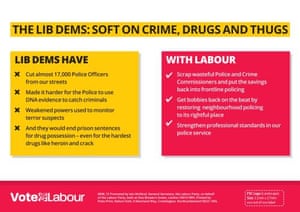
But if you are trying to woo voters who at the most recent general election voted for a liberal party, why on earth, 5 weeks out from polling day would you release this leaflet?
The Labour leaflet attacking the Lib Dems on crime.


I am particularly referring to the final bullet point on the "Lib Dems Have" side:

"And they would end prison sentences for drug posession - even for the hardest drugs like heroin and crack".

Now to me this just seems like a cynical attempt at vote grabbing. I suspect even those who drafted this leaflet know the current legal regime around drugs is self-defeating and damages the most vulnerable in society. But I think campaigning in this way is actually very misguided if you think about it.

Labour's best shot at being the largest party in parliament is by holding onto (and getting more of) those people who voted Lib Dem last time. Whatever else the Lib Dems have done, as a party their drugs policy is very clear. Indeed it is one of the most distinct "clear yellow water" issues between the Lib Dems and the two main parties. And many Lib Dems really, really like that policy. I know from personal experience having been one for several years. In all my discussions when I was a member on this subject (and that is a lot) I can count on one hand the number of Lib Dems I met who thought the current laws on drugs are right to stick with. This even applied to the older generations of Lib Dems in my experience.

So if anything, campaigning like this is likely to push wavering former Lib Dem voters back towards the yellows. Or at the very least make them hesitate when deciding whether to put their cross next to Labour. And let's not forget there are other options out there for voters too. The Greens also have a very progressive drugs policy and I am sure this will have pushed some who were going to vote Labour towards them too.

Labour should probably be grateful that this leaflet and the reaction to it in the media has largely been confined to online comment and articles in The Independent and The Guardian. Because the wider coverage this gets, the more likely I think it is to actually cost Labour votes.

They have fallen back on what they think is a "safe" issue to campaign on when in actual fact it is anything but for them given the current political situation.

Friday, 6 February 2015

Hoist by their own petard

Labour activists and left leaning commentators have been bemoaning how unfair it is that ever since the Scottish referendum, the SNP have been going around claiming that because Labour campaigned together for the No side they are just the same as the Tories.

The SNP have indeed been claiming this and this has almost certainly added impetus to their recent surge leaving Labour (if the polls are to be believed) at risk of losing a majority of their Scottish held seats.

It is ridiculous that Labour would be considered to be exactly the same as the Tories just because they happened to be on the same side in a particular campaign. It's the sort of stupidly simplistic argument that we see far too often in politics.

But I am afraid my response to Labour on this is "Ah Diddums".

Because "Labour are exactly the same as the Tories" in Scotland is pretty much identical to  "The Lib Dems are exactly the same as the Tories" in the whole of the UK, a line Labour has been pushing since 11th May 2010. A claim which is equally as ridiculous that just because a party is in coalition with another party that means they are now exactly the same party.

I for one am delighted to see Labour being hoist by their own petard in this way.

Tuesday, 6 January 2015

House of Comments - Episode 117 - Reviews and Predictions

House of Comments podcast is back!

I'll be doing these fairly regularly in the run up to the general election, just me hosting and usually one guest per week looking at recent political developments.

This week I am joined by Left Foot Forward editor James Bloodworth to discuss the political highlights of 2014 and to look forward to what 2015 has in store. Topics include the rise of UKIP (inevitably), Labour's diminishing poll lead, the Scottish referendum and aftermath and Russia's annexation of Crimea.

You can subscribe to the podcast on iTunes here.

Other podcasting software e.g. for Android can be pointed here to subscribe.

You can download the mp3 for the latest episode directly from here.

Or you can listen to the embedded episode below here:


Any feedback welcomed in the comments below.


PS: A big thanks to Audioboom for hosting the podcast. We would also like to thank Kevin MacLeod from Incompetech.com for our theme music.

Wednesday, 17 December 2014

Sanctimonious hypocritical rubbish from Labour on the NHS

I read this piece on LabourList today from a Labour candidate in Brighton and I am afraid I couldn't help myself but post a somewhat ranty response in the comments below it.

I thought I'd reproduce it here seeing as it's the longest thing I've written in a while!


What an absolute load of sanctimonious tribalistic rubbish. You didn't "rebuild" the NHS in 1997 and you won't need to "rebuild" it in 2015. It was perfectly functional when your party came to office in the 1990s and will be so next year if you win.

Your comments about cuts should be seen for what they are - hypocritical. The current government has ring fenced NHS spending against their cuts. Tiny rounding errors where money is either not spent in an area or rolled into the next year are screamed about by your party as "CUTS"! But your party made no such pledge about ring fencing the NHS so the readers can draw their own conclusions about what would have happened had you won in 2010.

The administrative problems you refer to regarding the closure of a GP surgery in Brighton is the sort of thing that happens under all governments not just this one. There were loads and loads (and loads) of admin issues under Labour. I remember Tony Blair getting an absolute roasting from a BBC Question Time audience during the 2005 general election campaign when one audience member highlighted how they could not book an appointment in advance and had to ring on the day first thing in the morning when they could often not get through. Blair said he was sorry and it must be particular to that one surgery at which point many more people in the audience spoke up about how they had exactly the same problem across a variety of surgeries. I myself had experienced it too. It was systemic. It was still happening late in the previous parliament when Labour had had over a decade to sort this out. Was that SAME OLD EVIL UNCARING LABOUR??!!! or is it simply that a massive bureaucratic service like the NHS is by definition very difficult to manage and when you have all sorts of targets (some of which contradict each other) administrative failings like this are inevitable. It's nothing to do with the party or parties in power usually. It's just the nature of complex systems.

Your party might have been in power when the NHS was founded but there was a clear pre-war consensus that something like it was going to happen and the Beveridge report which was the foundation of the NHS was produced by a member of the Liberal Party. Your party does not own the NHS like so much of your rhetoric and this piece would imply. It is owned by all of us. And it is not just Labour members and voters who care about it. We all do.

And finally, this is probably a controversial point because Cameron himself has unwisely referred to the death of his son probably too many times in this context but to suggest as you do that Cameron personally does not understand the value of the NHS is simply factually incorrect. Anyone who has had a sick/terminally ill child understands intuitively the value of it. It is very unwise of you to suggest otherwise.


Wednesday, 15 October 2014

Labour agreed with Freud's "Therapeutic Work" idea in 2003

Ed Miliband has managed to dominate today's news cycle with his revelation that Lord Freud, speaking at Conservative conference 2 weeks ago made comments implying that some disabled people may be better off if they were not paid the full minimum wage.

Outrage aplenty today from almost everyone on the left and also lots of disability charities.

But in 2003, whilst Labour were in power, the government published an "Information Note" entitled "The Minimum Wage and Therapeutic Work" (opens PDF).

The document seeks to clarify the legal status of certain groups of people such as those who are disabled with reference to the minimum wage.

With reference to potential therapeutic work it states: "There may be no employment contract if there is no mutual obligation between the parties i.e. the individual is genuinely not obliged to perform duties and the employer is genuinely not obliged to provide the activity or pay the individual."

It then goes on to give a number of examples where it considers the minimum wage would probably not apply such as this one:

(c) A trust runs a facility for mental health out patients, who do various activities such as packing and assembly. They are paid varying amounts up to £20 per week. If they do not attend there are no sanctions. If they go along and do not want to do any activity they don’t have to. There is a production line but the speed is set by the users and if they want to they can turn it off;

Surely this idea is not far off what Lord Freud was saying today? That there may be circumstances where disabled people could derive benefit from a working situation where they were not paid the full minimum wage. Of course Freud did not heavily caveat and nuance his statement and it was clearly not properly thought through.

But the fact that when in power Labour clearly recognised there could be cases where disabled people could provide labour in limited circumstances and not be remunerated to the full extent of minimum wage law demonstrates that Freud's is not such an outlandish idea.

That won't of course stop Labour from continuing to attack him until he eventually has to resign which I predict will happen before the weekend. Because seemingly one thing you never have to worry too much about in politics is being consistent.

Not when there's a shitstorm to kick up anyway.


Hattip to Senior Sceptic on Twitter for highlighting this document to me.

Saturday, 19 April 2014

Since 2010 the Government has been more popular than Labour

In 2010 something quite remarkable happened.

Two parties came together, they claimed in the national interest (although some would of course dispute that motive) to form a coalition in order to govern the country for the next 5 years.

It has been difficult for the Conservatives and Lib Dems. They haven't always agreed and there have been at time bitter arguments between them. However they have managed to remain in government together and nobody now seriously thinks that they will not last another year until polling day on May 7th 2015.

In the meantime, the Labour opposition have tried to find different ways to position themselves against the government. They have been quite inventive in this. They have referred to it as a "Tory led government" as they clearly think this is a good attack line. They have at times accused the Lib Dems of "betraying" their voters and also implied that this government has no mandate as nobody specifically elected the coalition. They have questioned the motives of ministers of both parties in the way they have implemented the cuts, claiming they are "ideological". They have berated the government for being heartless, out of touch, in the pocket of millionaires and many, many, many other such attacks.

This has been rather effective. Look:


Labour climbed ahead of the Tories in the polls a few months after the 2010 general election and apart from a slight blip a year or so later when the Tories briefly overtook them they have basically stayed ahead. The Lib Dems slid down to around 10% and have bumped around at that level ever since.

Surely based on this Labour is winning the argument and the public would prefer Labour then?

Well not quite actually. Look:


If we combine the totals of both the Conservatives and the Lib Dems, (i.e. the two parties of government) then that combined total has largely been ahead of Labour. There's a bit of crossover around the time and for a while after the "Omnishambles" budget of 2012. But for the majority of the time and certainly quite recently the "government" total has been ahead.

Of course the Conservatives and the Lib Dems are two separate parties. They won't be merging or standing on joint tickets, or even going for some sort of "coupon" agreement next year. They will stand separately. But Labour consistently attacks and berated the entire government. The pejorative term "ConDem" government is used to great effect in their campaigning. So if they are going to attack the entire government it is only fair to look at the figures in that context. And that shows us that despite the fact that for 4 years the government has had to make swingeing cuts and has launched unpopular reforms in all sorts of areas, they are still more popular than the Labour opposition.

If I was a Labour politician or activist I'd be very worried about this.

Friday, 27 September 2013

Power Trip by Damian McBride - Review

When Iain Dale first made public the fact that Damian McBride was going to publish a book about his experiences as Gordon Brown's spin doctor I instantly suspected it was going to be one of the most important political books of the decade.

Despite largely being out of favour since he was fired in April 2009 as a result of the leak of the "Red Rag" emails, in recent times he had begun something of a political rehabilitation due to his brilliantly written blog where he would occasionally comment on former and current political events. In this format he wrote with sincerity, self-criticism and with deep insight regarding the issues he was covering. In particular I recall his blog post* following the omnishambles budget last year where he revealed the secrets of the "score card" system that had been used during his time at the Treasury and how the fact that some of the measures that Osborne had tried to introduce would never had (and indeed didn't) made it through in his time thus demonstrating weaknesses in the current setup.

So it was clear that McBride is an excellent writer of long-form blog posts (my favourite kind) and he clearly had lots of experience at the heart of the Labour government. I was therefore greatly looking forward to the release of Power Trip: A Decade of Policy, Plots and Spin. I am happy to say that I have not been disappointed.

The first thing to say is that I think the book is structured very well. It is essentially in the form of 52 long-form blog posts. As this was clearly a format that worked well for him the decision to structure it in bite-sized chunks certainly seemed to work. I suspect there was more than a little of Dale's influence at work here, himself an experienced and successful political blogger. One result of this decision is that although the book does follow a sort of chronology there is a fair bit of jumping about in order to link things that had happened previously and that also happened in the future that were relevant in some way or that presaged later events. But I think it works as a device as it helps set the context and also shows like a flashing beacon as the book progresses the car crash that is inevitably coming.

When I saw McBride interviewed by Jeremy Paxman on Newsnight just before the book's publication Paxman rather sneeringly (as is his wont) asked him how we could believe anything in the book given that in various places in it he admits to having previously lied when a spin-doctor. I can't be 100% sure that everything in the book is 100% true but all I can say is it reads as if written from the perspective of someone who is deeply sorry about the worst of his actions and is still trying to come to terms with the person he became as he was sucked further and further into the mire of dirty politics.

I'm not going to single out any of the revelations in the book as they have been done to death in the mainstream media. I knew a few of them but there are plenty that were new to me. It is really however more interesting for the general picture it paints of life as close adviser to Gordon Brown.

Brown comes across as a kindly but irascible figure, prone to outbursts of temper whilst also capable of extraordinary acts of kindness such as his words to McBride on the death of his father about how proud he must have been of him and his brothers whilst he sat there in a pub with tears rolling down his face. Brown is also painted as an intellectual titan and voracious reader who never, ever stopped thinking about politics and what the next job was.

A laugh out loud moment is when he has to deliver bad news early on to Brown who predictably reacts badly, shouting with his fists balled moving towards him (although McBride makes clear Brown was never physically violent towards anyone in his experience) and he figures the best response is to get angry himself so he starts shouting, swearing and kicks over a chair. At which point Brown instantly stops and tells him to calm down! An interesting tactic I might have to remember myself one day.

The two Eds, Miliband and Balls regularly pop up and are treated sympathetically. They come across as highly intelligent both with economics and also politics and are key figures throughout the book. There are also some interesting insights from McBride as to what drives each man based upon his up close observations. The section where Ed Miliband eventually decides he can't trust our protagonist any more is chilling with respect to the sang-froid with which the final call where he repeatedly tells him he thinks he is a "liar" is delivered. Food for thought for anyone who thinks Miliband does not have the steel to be Prime Minister one day. He clearly does if this is anything to go by.

On the subject of dirty tricks which are covered extensively McBride goes into lots of detail as to how stories were leaked, political editors and reporters effectively bribed with "better" stories to head them away from things he and his boss would not have wanted splashed on the front pages and generally would seem to serve as a guide to spin-doctoring. I suspect many current and aspiring spinners will be scouring this book for tips and tricks from one of the best in the business. McBride even seems to implicitly point to his not being there as one of the main reasons for various media cock-ups such as the Gillian Duffy episode from the 2010 election where Brown was inadvertently recorded describing her as a "bigoted woman".

One criticism I would level at the book is that some of his behaviour towards the Blair camp is brushed off with a rather insouciant "they were as bad as we were" mentality. I have to say that from what I know of what happened on the Blair side of the camp, yes they were not great but any objective analysis would surely show that the Brown spin camp spearheaded by McBride were worse. Indeed McBride spells it out in painstaking detail throughout the book rather undermining his complacency in this area. A little bit more humility about this would have helped I feel.

Overall though it is an excellent read and for a political geek like me there was enough behind the scenes colour and filling in the gaps for episodes that I recall seeing unfold from the outside to keep me glued to it for the 2 days (on and off) it took me to read it. It does however lend itself to dipping in and out of due to the blog like nature of it as described earlier.


I would certainly recommend this book to anyone interested in politics and/or the processes that go on behind the scenes. I suspect that all the main movers and shakers of all parties will have it on their reading lists, and that's if they haven't already read it. In the world of Westminster there is almost no bigger compliment for political memoirs. It shows you once mattered and Damian McBride certainly did.


PS: We covered the fallout from Damian McBride's book in this week's House of Comments podcast recorded in Brighton at the Labour conference.


*Incidentally his entire blog now appears to have been taken off the internet, perhaps because of the publication of this book but his budget post can still be seen in this cross-posting on Liberal Conspiracy.


Monday, 15 July 2013

New Liam Byrne letter discovered

In the light of Liam Byrne's announcement today that suddenly instead of hating the idea of a benefits cap, Labour now think it doesn't go far enough a letter to Ed Miliband from Liam has been discovered.


Monday, 17 June 2013

No confidence in "Confidence and Supply"

Liam Byrne has come out in favour of a minority Labour government if there is a hung parliament where Labour are the largest party after the 2015 general election.

His view is that he thinks a minority Labour administration could achieve more than a coalition and also that the current government has "given coalitions a bad name".

In some ways this view is unsurprising. In the political memory of almost everyone in the contemporary PLP (at least in the Commons) they have never had to share power. Their experiences in government between 1997 and 2010 were of sole stewardship of the levers of government and it is hardly surprising that elements within would want to repeat that, even if the electorate did not want to give them a majority.

But there is an implicit assumption built into this idea from Byrne. For a minority government to have any stability it would require minor parties (likely including the Lib Dems) to be willing to agree a "Confidence and Supply" arrangement with Labour. This would mean them promising to support Labour in any confidence motion and also to allow budgets to pass.

I have previously detailed my views on confidence and supply explaining how I think it would give all of the downsides of a coalition but without many of the benefits. This would apply just as much in a potential arrangement with Labour as it would with the Conservatives.

I do not think my views on this are unusual. There are plenty in my own party who feel similarly, indeed that is one of the main reasons that the 2010 coalition went ahead as the alternatives were all worse in the views of the key negotiators.

So if Byrne's view prevails within Labour and they as the largest party in a hung parliament try to go for a minority government that is predicated on some pretty big assumptions about how smaller parties will fall into line and provide the day to day support needed to even perform the basic functions of a government. It is far from clear that would be forthcoming and it is somewhat arrogant in my view for Byrne to simply assume that it would and that somehow it would mean Labour could achieve more than it could in a coalition. In fact this is the same arrogance that Adonis betrayed in his book "5 Days in May" (that I reviewed here) where he and other senior Labour figures were convinced a coalition with the Lib Dems could work despite the maths not favouring such an arrangement based on a series of assumptions about how all the other parties would back them.

To an extent I can understand Byrne's wish to find a "better way" to govern were there to be a hung parliament. There is no denying that coalition has been tough and from the outside looking in to Labour politicians I can see why they might balk at such an arrangement themselves.

But the idea that a minority government would be better strikes me as tribalistic and short-sighted. Any minority government is unlikely to last more than a year or two and parties who show they are unwilling to work with others may well find they are punished at the ballot box at least as much if not more than those who are willing to take the risk of going into coalitions.

Saturday, 15 June 2013

Lib Dem till I die?

My membership renewal for the Lib Dems came through this morning. It marks five years since I first joined the party.

This anniversary has reminded me of something I have been meaning to write about for a while. The continuum on which political activists of all parties sit.

Regular readers will know that I do a weekly podcast with an old friend of mine Emma Burnell who is a Labour activist. Emma joined Labour back when she was a teenager and has spent the last 20+ years campaigning for them and being a highly active member involved with all sorts of internal organisations over the years. She is happy to describe herself as a "tribalist" and whilst I have some quibbles with her over the exact definition of that word I agree that even by my stricter interpretation of its meaning, she is one!

Emma has made it clear that pretty much no matter what the Labour party did she would stick with them and if she was unhappy try to change the party from inside. As far as it is possible to be she is "Labour till she dies".

Another friend of mine, Caron Lindsay is a very long-standing member of my own party the Lib Dems. Like Emma, Caron has been involved with the party from a very young age and has been on various internal committees and held various positions within it. Also like Emma, Caron has made it clear that she is also in this party for the long haul. She is to all intents and purposes "Lib Dem till she dies".

Which brings us to me. Although I am of a similar generation to Emma and Caron and am probably obsessed with politics to a similar extent (and have been since I was a child) I chose not to get involved with a specific party until 2008. And I think this matters. I do not have as much vested within my chosen party. Whilst I know quite a few people within the Lib Dems fairly well they are all somewhat recent acquaintances. My long-standing friendships are all with people who are outside my party and in most cases politics altogether. So my roots do not go anywhere near as deep.

There are certainly scenarios I could imagine that could lead to me leaving the party. In fact I actually came pretty damn close earlier this year when the secret courts legislation was passed by my party in government in direct opposition to what the members of the party wanted. In the end I restricted myself to pledging to refuse to campaign for any Lib Dem MP who voted for the measure. But I had several dark nights of the soul and it could have gone the other way.

So despite being in different parties from each other, Emma and Caron probably have much more in common with each other as political activists than either of them do with me.

I think there is a continuum at work here. I am quite close to one end of it - very interested in politics and in a party but without a deep seated rooting within it and my friends are close to the other end of it - so heavily invested in their parties that they cannot really imagine ever leaving it.

I think parties need those of us who would consider leaving, performing a similar service to the floating voters in the wider electorate reminding party hierarchies that they cannot take their membership for granted.

Maybe if I stick around then by 2023 or 2033 I will be the sort of "cut me and I bleed yellow" activist that form the core of activists for political parties but I am certainly not there yet.

But I have renewed my membership for another year. That gets me another year closer to perhaps eventually being one!